

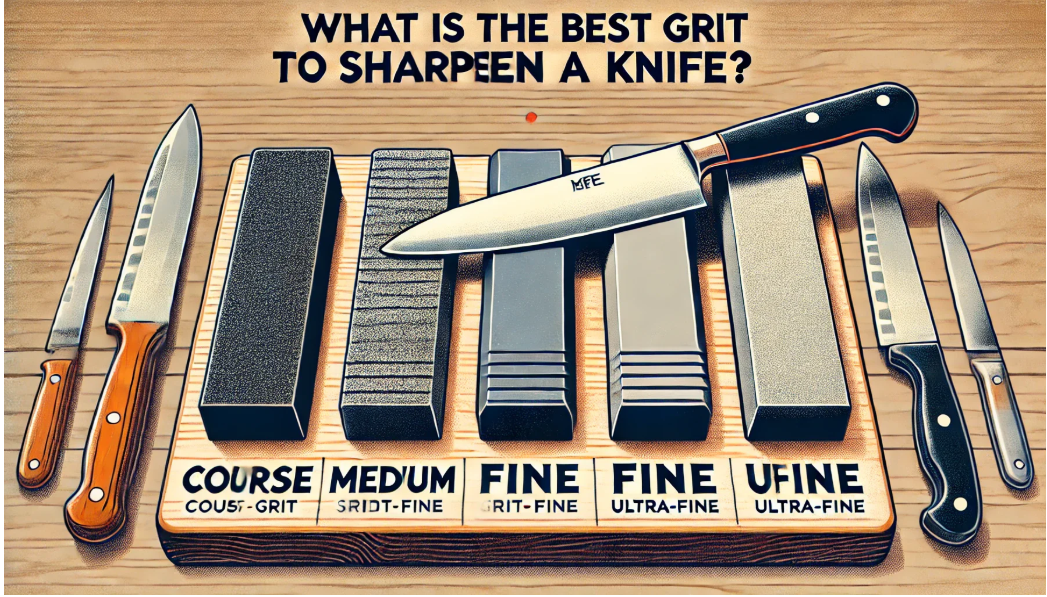
You’re standing at your workbench or kitchen counter, looking down at a knife that can barely slice through a tomato, let alone clean a piece of game or survive a rugged weekend in the field. You know it’s time to sharpen it. But as you look at the endless options of sharpening stones online, you hit a wall of choice paralysis.
Do you need a 400-grit diamond bar? A classic 1000-grit corundum oil stone? Or a 3000-grit ruby polishing stone? What do the numbers actually mean, and where do you start?
Skipping grits or starting on the wrong stone is the #1 reason people ruin their edge or spend hours grinding away with zero results. Welcome to The Definitive Grit Guide. Let’s break down the exact anatomy of knife sharpening grits, what they actually do to your steel, and how to build the perfect progression for a screamingly sharp edge.
The Core Grit Breakdown
To understand how sharpening works, it helps to see the stages side by side. A complete sharpening sequence moves sequentially from structural repair to surgical polishing.
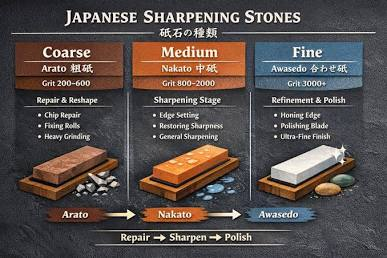
1. Coarse Grits (Roughly #120 to #600) – The Heavy Lifters
What they do: Rapid Metal Removal & Edge Profiling
Think of coarse grits as the demolition crew of the sharpening world. These abrasives feature large, aggressive particles designed to rip away damaged steel fast.
If your knife is completely dull, has visible chips in the belly, or an uneven secondary bevel from years of bad sharpening, a fine stone won’t save it. You need a coarse grit to fundamentally reshape the edge and grind a brand-new cutting apex.
- When to use them: To repair chips, fix a broken tip, re-profile a thick outdoor blade, or sharpen a knife that is “butter-knife dull.”
- Abrasive Types: High-density Diamond Bars or aggressive Green Silicon Carbide stones excel here because they cleanly cut through tough modern super-steels (like D2, S30V, or M390) without losing their flatness.
- The Golden Rule: Do not try to get a knife “shaving sharp” here. Your goal on a coarse stone is simply to establish a clean, straight bevel and form your first consistent burr (the microscopic wire edge that tells you you’ve reached the apex).
2. Medium Grits (Roughly #800 to #1500) – The “Everyday” Edge
What they do: Refining the Apex & Setting the Tooth
If your knife isn’t damaged but has just lost its clean biting edge from normal daily use, this is your starting point.
Medium grits bridge the gap between heavy repair and mirror polishing. They erase the deep, ragged scratches left behind by coarse stones and refine the cutting edge into a crisp, uniform apex. A medium grit leaves what bladesmiths call a “toothy” edge—microscopic serrations that act like a miniature saw blade, allowing your knife to aggressively bite into meat, rope, and veggies.
- When to use them: For routine maintenance, sharpening standard kitchen cutlery, and finishing hard-use work knives.
- Abrasive Types: Classic fused Corundum (Aluminum Oxide) stones are the gold standard for medium grits. They offer incredible tactile feedback through your hand or manual guided systems, letting you feel exactly how the edge is developing.
- The Golden Rule: For 90% of working knives (like a chef’s knife or a daily carry pocket folder), a highly refined medium grit edge is perfectly sharp enough for 95% of daily tasks.
3. Fine & Polishing Grits (Roughly #2000 to #5000+) – The Surgical Razor
What they do: Micro-Burr Eradication & Mirror Polishing
Welcome to the luxury tier of sharpening. Fine and ultra-fine grits do not remove bulk metal; instead, they polish the existing apex down to a microscopic scale.
When you grind steel on coarser stones, a tiny, flexible flap of metal (the burr) hangs off the edge. Fine stones cleanly shear away this micro-burr and refine the scratches on the bevel until it acts like a mirror. This minimizes friction, allowing the blade to glide effortlessly through materials with push-cuts rather than slicing motions.
- When to use them: Final honing of straight razors, high-end Japanese kitchen cutlery, precision leather skiving tools, woodcarving gouges, or creating a show-stopping presentation edge on a custom build.
- Abrasive Types: High-purity sintered Ruby Crystal Stones (#3000 grit) or ultra-fine diamond plates are phenomenal here. Solid ruby crystal is incredibly hard, meaning it will never “dish out” or lose its flatness, ensuring your precision angles remain mathematically perfect.
- The Golden Rule: Never jump straight to a fine stone if your knife is truly dull. A 3000-grit stone on a dull knife is just polishing a round edge—it will make it look shiny, but it won’t make it cut.
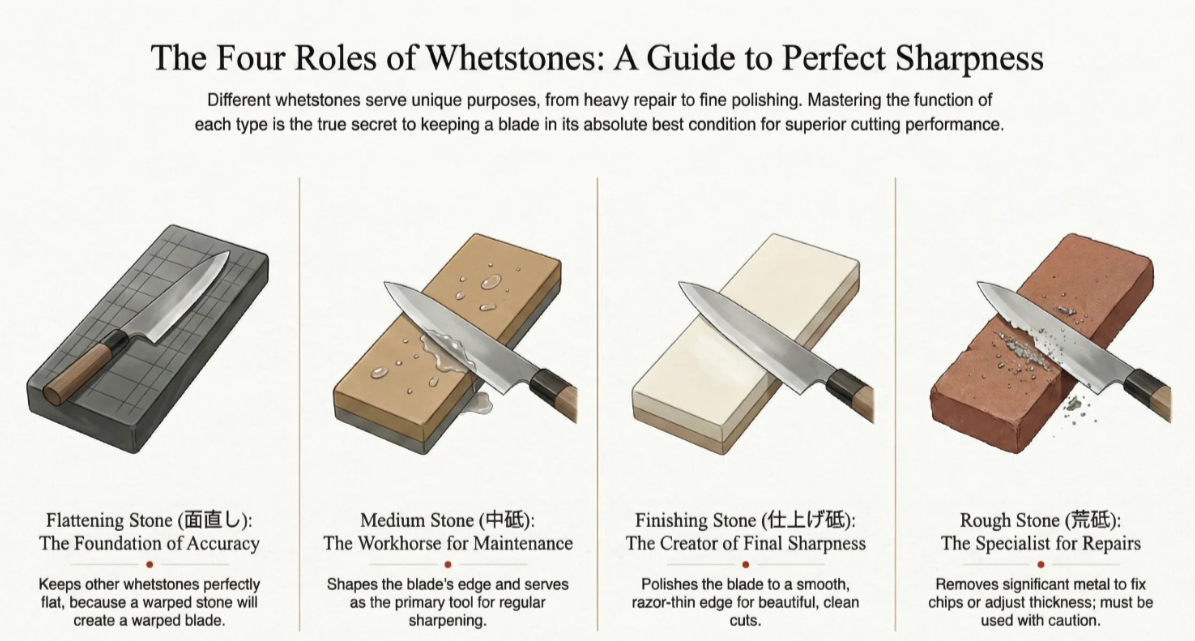
How to Build Your Ultimate Sharpening Progression
You don’t need ten different stones to get a professional edge, but you do need a strategic roadmap. Here are the three most effective progressions depending on your setup:
Option A: The “Do-It-All” Minimalist (Double-Sided Bench Stone)
If you want a clean, space-saving bench setup for a mix of kitchen cutlery and EDC folders, a Double-Sided Diamond Whetstone Block is unmatched. Use the coarse side to set the edge in seconds, flip it over to the fine side to clean up the scratches, and finish on a leather strop.
Option B: The Precision Guided System (6 to 10-Piece Kits)
If you struggle to hold a perfect angle freehand, using a guided sharpening system (like a Ruixin Pro or Edge Pro jig) paired with a sequential Multi-Piece Diamond or Corundum Progression Kit ensures you never make a blind grit jump. You can smoothly step from #200 to #1500 without guessing, resulting in a perfect, factory-grade edge every time.
Option C: The Curved & Specialty Weapon (Cylindrical Rods)
Sharpening a recurve blade, a karambit, or deep serrations? Flat stones won’t work. You need to map your grits using a Cylindrical Diamond Grinding Rod that can cleanly ride inside the concave curves of the steel.
Ready to Upgrade Your Workbench?
The secret to a legendary edge isn’t magic—it’s having the right abrasive for the right job. Whether you need to aggressively rebuild a battered bevel or polish a custom hunter to a mirror finish, we have you covered.
👉 [Explore our complete collection of Diamond Bars, Ruby Polishing Stones, and Complete Alignment Kits here!]