

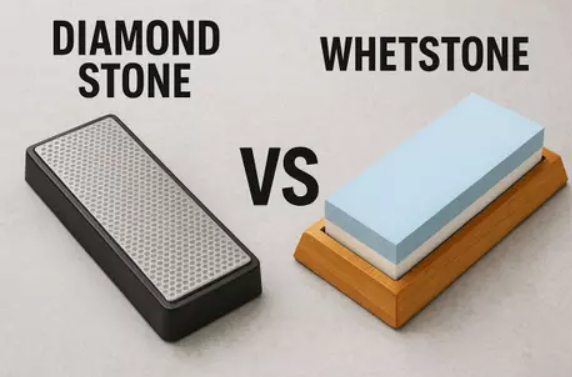
If you step into any online knife forum, bladesmithing group, or YouTube comment section and ask, “Should I buy a diamond sharpening stone or a traditional whetstone?” you are going to get a hundred passionate, conflicting answers.
One side will tell you that traditional whetstones offer unmatched edge precision and an ancient, zen-like sharpening experience. The other side will swear that diamonds are an absolute superpower that slashes sharpening time in half.
It’s easy to get buried in technical jargon about monocrystalline matrices, micron sizes, and slurry breakdown. But you just want to know: Which one is going to give your specific knives the sharpest edge with the least amount of frustration?
Let’s skip the gatekeeping and break down the honest pros, cons, and real-world differences so you can choose the perfect tool for your workbench.
The Contenders: What Are They, Exactly?
Before we pit them against each other, let’s look at how they work:
- Diamond “Stones”: These aren’t actually blocks of stone. They are flat metal plates electroplated with a dense layer of microscopic industrial diamond crystals. Because diamonds are the hardest known material on earth, they don’t break down; they aggressively shear away metal.
- Traditional Whetstones / Oil Stones: These are blocks made of synthetic or natural abrasive crystals (like aluminum oxide or silicon carbide) held together by a bonding agent. As you rub the knife on the stone, the stone surface intentionally wears away, exposing fresh, sharp layers of abrasive underneath. (Fun fact: The “whet” in whetstone just means “to sharpen”—it doesn’t mean “wet,” though many do use water or oil as a lubricant!)
1. Speed and Aggressiveness
🏆 Winner: Diamond Stones
If your time is valuable, diamonds win by a landslide. Because diamond crystals are incredibly hard and sharp, they bite into steel instantly.
Traditional stones can take a long time to grind down a seriously dull blade or reset a secondary bevel. A coarse diamond plate will do the exact same amount of work in a fraction of the time. If you have zero patience for grinding a knife for 40 minutes, diamond is your answer.
2. Dealing with Hard “Super-Steels”
🏆 Winner: Diamond Stones
Modern pocket knives and high-end outdoor blades are often made from advanced “super-steels” (like D2, S30V, M390, or Maxamet). These steels are packed with incredibly hard vanadium and niobium carbides designed to resist wear.
Traditional aluminum oxide whetstones can struggle against these modern alloys—the steel is literally harder than the stone, causing the knife to glide over the top without getting sharper. Diamonds do not care. A diamond plate will cleanly cut through any modern super-steel or ceramic blade with absolute ease.
3. Maintenance and Flatness
🏆 Winner: Diamond Stones
This is the biggest hidden frustration of traditional whetstones: they wear down in the middle. Over time, freehand sharpening creates a “swale” or valley in a traditional stone (called dishing). If your stone isn’t perfectly flat, it ruins your sharpening angles. To fix it, you have to buy another specialized flattening stone to grind your whetstone flat again.
Diamond plates are built on solid steel or aluminum cores. They stay 100% perfectly flat forever. They never dish out, they never warp, and they require zero maintenance.
4. Edge Feedback and “The Bite”
🏆 Winner: Traditional Whetstones
So, if diamonds are fast, flat, and indestructible, why does anyone still use traditional whetstones? The answer is tactile feedback.
When you sharpen on a traditional stone, it creates a “slurry” (a muddy mixture of shed water and loose abrasive crystals). This slurry acts like a cushion. It gives the sharpener incredible physical feedback through their hands—you can literally feel exactly when your blade angle is perfect. Diamonds can feel loud, scratchy, and aggressive by comparison. Furthermore, traditional stones are much better at leaving a micro-toothy “bite” on softer kitchen cutlery, making them a favorite among professional chefs.
5. Mess and Prep Time
🏆 Winner: Diamond Stones
Traditional water stones require you to soak them in a bucket of water for 10 to 20 minutes before you can even use them, and they create a muddy puddle on your counter. Oil stones require messy honing oils to float away metal dust.
Diamond plates are ready instantly. You can use them completely dry for a 30-second field touch-up, or just spray them with a quick splash of water to keep things clean. When you’re done, you just wipe them dry with a towel.
The Verdict: Which One Should You Buy?
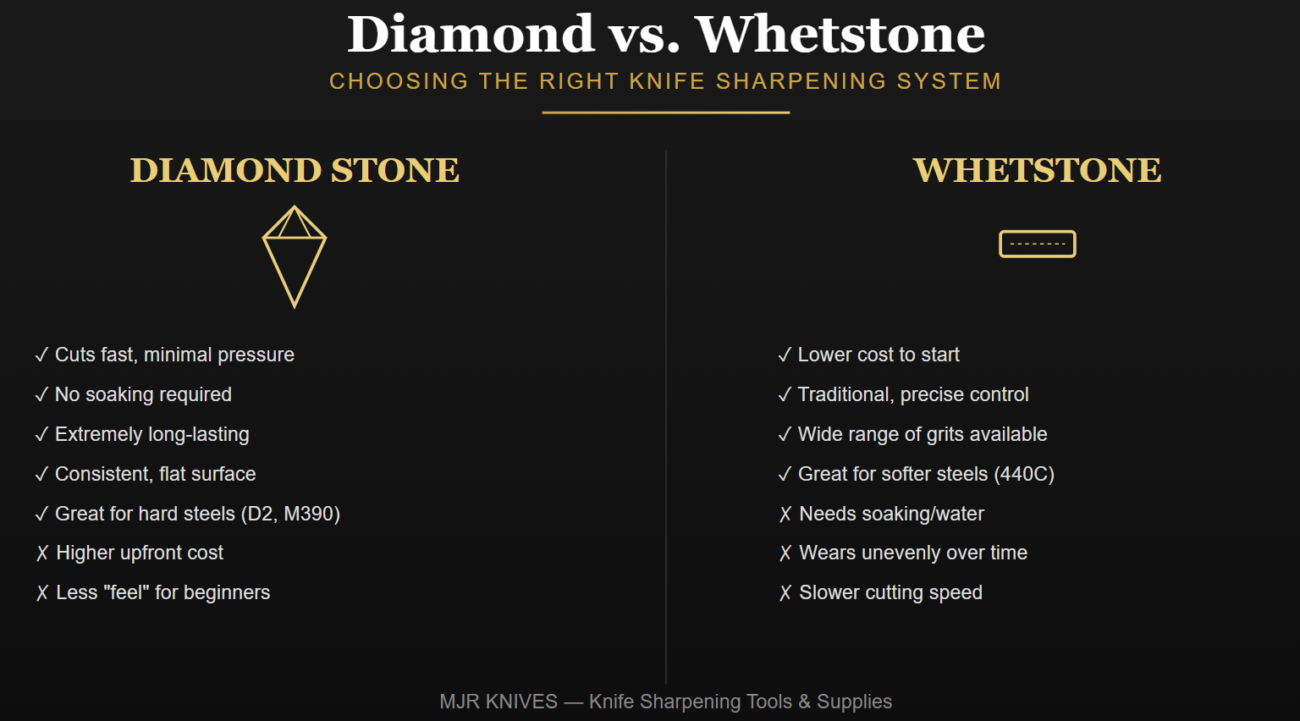
Instead of declaring one “absolute best,” choose the tool that matches your gear collection and workflow:
Choose Diamond Stones If:
- You own modern pocket knives or survival blades made of hard alloy steels (D2, S30V, etc.).
- You use manual, guided-angle sharpening systems (like a Ruixin Pro jig), where absolute stone flatness is required to keep your angles mathematically perfect.
- You hate maintenance and don’t want to deal with soaking stones or flattening dished surfaces.
- You want the fastest possible results with minimal mess.
Choose Traditional Whetstones If:
- You are primarily sharpening standard German or Japanese kitchen knives, woodworking chisels, or traditional high-carbon pocket folders.
- You want to master the artistic, freehand style of sharpening and value that tactile, smooth feedback through your hands.
- You enjoy the relaxing ritual of soaking your stones and working up a beautiful polishing slurry.
Ready to Build Your Perfect Edge?
Whether you want the fast, unyielding power of a diamond setup or the smooth, precision feedback of a classic shop stone, we have the exact tools you need to get your blades screamingly sharp.
👉 [Browse our Professional Diamond Plates and Premium Shop Whetstones here to find your perfect match!]